Burst Consolidation
You can elect to combine multiple Excel outputs generated from a burst into one output file - i.e. consolidate multiple Excel files into one. This is handy when what you are after is a single Excel workbook of all the results or a single PDF file containing multiple sub-reports rather than individually generated outputs.
Note
Consolidation is only available for sub-reports that include an Excel Presentation layer. It is not available for DAS-format or data-only outputs. If generating a consolidated PDF, still select an Excel output for the sub-reports but then select PDF from the Consolidation menu.
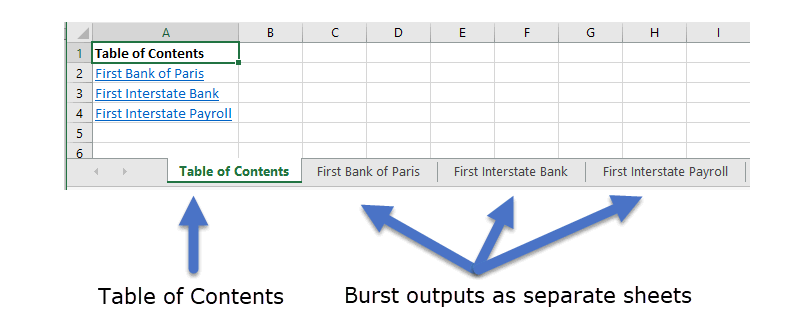
For comparison, without consolidation (i.e. selecting the Distribute separately option), each of the worksheets above would be saved as separate files.
To specify output consolidation, on the Burst Output Settings form:
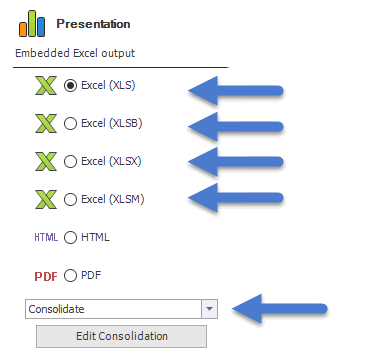
Click one of the Excel Presentation formats and select Consolidate. This will enable the Edit Consolidation button.
Next, click Edit Consolidation:
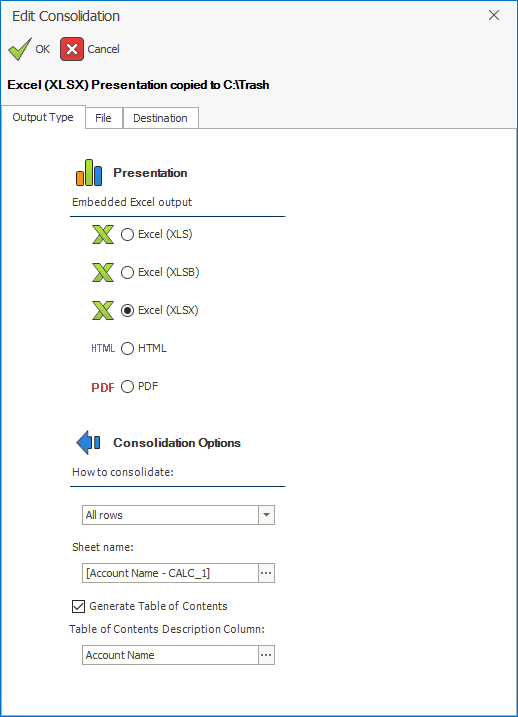
The Edit Consolidation window has three tabs — Output Type, File, and Destination — described below.
Output Type Tab
On the Output Type tab, specify the presentation output format for the consolidated output by selecting one of the available output type options, then set How to consolidate to either All rows or Each row.
All rows
All rows from the burst driver end up on a separate sheet in one consolidated file.
Sheet name: Use the visual assist to select tokens that will determine the titles of the sheet names. In the example above, each sheet will be named with the account name for the burst driver row. If you specify a naming rule that results in a non-unique name for each sheet, DAS will make each sheet name unique with an incremental index (i.e. Sheet (1), Sheet (2), etc.).
Table of contents: If you check Generate Table of Contents, DAS will create a basic hyperlink cover page for your consolidated output to make navigating to the sub-sheets easier. In the Table of Contents Description Column, select a burst driver column that provides the description you want shown in the Table of Contents. In the example above, we pick the account name because for our consolidation, the account name is unique and describes the page to which we would want to navigate. Normally this column and the sheet name are a unique description for each burst item that is meaningful to your end-user.
Each row
Each row from the burst driver becomes a separate output file, and all the burst target reports for that row are consolidated into that file. This option only makes sense if you have multiple burst targets in your burst driver report — i.e. each row is creating more than one target output.
Sheet name: The Sheet name option is greyed out. Sheet names are instead taken from the sheet name of the underlying Excel Presentation layer for each sub-report. Any modification to the sheet names will need to happen in their respective sub-reports.
Table of contents: If you check Generate Table of Contents, DAS will create a basic hyperlink cover page for your consolidated output to make navigating to the sub-sheets easier. The Table of Contents Description Column will be greyed out for Each row and instead utilize the Grid Column name specified in the calculation editor for each burst calculation used in the consolidation.
Sheet Ordering
The order of the sheets in the consolidation workbook is based on the left-to-right order of the visible calculated burst columns in the driver report.
File Tab
Use the File tab to name the consolidated output file and set whether it is distributed when empty. The options are the same as those described in Burst Output Settings: File Tab.
Destination Tab
Use the Destination tab to send the consolidated output to an email or a save destination. The options are the same as those described in Burst Output Settings: Destination Tab.
Note
All burst calculations in a report utilizing the Consolidation option will inherit the same consolidation settings.